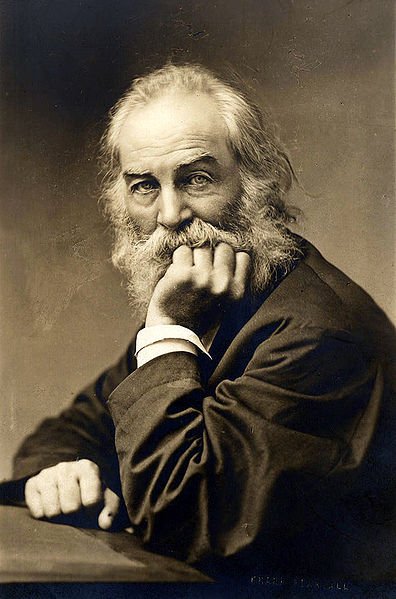

Walt Whitman: visionary of modern poetry in America
Poe died in 1849, and in 1850 a man of strong presence began to write his unique work in poetry: Walt Whitman, who is considered by many scholars as the father of modern poetry in America (Anglo-Saxon), thus establishing a founding parity with French symbolism, which was born in that decade (of which we will speak in next post).
Whitman is a kind of nova in the panorama of universal literature. The influence of his work, and even his figure, in modern poetry is inoculable, unavoidable. Before considering his contributions and influences, we will look at some of his biography and visit part of his work.
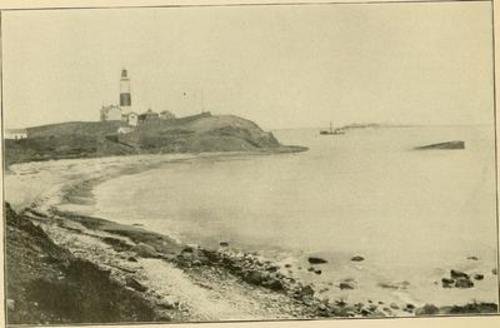
His name is Walter Whitman, like his father, but he promoted himself as "Walt". He was born on Long Island, New York State, in 1819, and died in Camden, New Jersey, in 1892. The son of humble parents, belonging to the religious community known as "Quakers," who had no definite creed and sought to revive primitive Christianity.
He is known as a poet, essayist, and journalist, but he did several types of work: typographer, teacher, government employee, and volunteer nurse during the American Civil War, among others. He founded his own newspaper, The Long Islander, of which he was simultaneously editor, journalist and distributor. He intervened in public and political action.
His masterpiece, Leaves of Grass, was published in 1855, although he began writing it in 1850. His first publication was at his own expense. It was revised and extended for the rest of his life, and the definitive edition was published in 1892. It was praised by Ralph Waldo Emerson, American philosopher and writer, leader of the movement known as Transcendentalism, of great influence at the time and to which Whitman was linked. His work was also admired by the American thinker and writer Henry David Thoreau, author of the famous book Walden and promoter of the concept of "civil disobedience". However, the receptivity of critics and certain sectors of public life was not favorable; he was rejected as obscene in his saying and offensive for his sexual issues.
He suffered a stroke and resided in Camden, New Jersey. He died when he was 72. His funeral is said to have been a public spectacle.
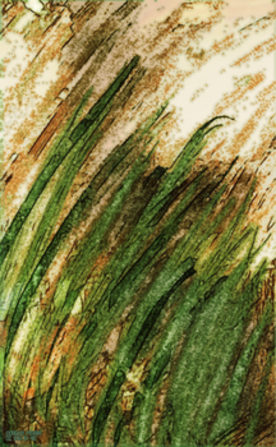
Source
Let's talk a little about Leaves of Grass and their literary and philosophical conception.
Leaves of Grass was the central task of his life; the work grew over the years, and, as the poet Rafael Cadenas has said, "Whitman undoubtedly lived for his book.
All Leaves of Grass is made, as a work, of a new poetic matter, and here are some of its main attractions. Whitman shows and declares in it his interest in common life; it is a lyric of things and the everyday, where the body and its sensuality, the space, the ordinary inhabitants, will speak through that plural voice that drives the poetic discourse. It is the mysteries of life that Whitman sings during the various parts of his work.
It is undeniable that Leaves of Grass is impregnated with the transcendentalist philosophical thought that influenced Whitman, who formulates the union of the world and God, with which he links, to some extent, with the pantheistic religious vision (the identity of God and nature), which can also be noticed in the American author. But also present in his grandiose work is the democratic and progressive vision, in which his identification with the political and civilizing ideas of modernity was manifested.
Attending to this rich cosmovision, the critic Guillermo Nolasco Juárez contributes:
With certain intuition he discovers within diversity the subtle unity, in stillness the everlasting movement (...)
Walt Whitman agrees with the formulation of change and becoming; he understands that things hold the possibility of transforming into other things.

In keeping with this general consideration of the poet's philosophical conception, which we could call dialectic, dynamic and open, so characteristic of modernity, the writer Octavio Paz synthesizes masterfully:
Poet of space, it has been said; we should add: poet of space in movement. Nomadic spaces, imminence of the future: utopia and Americanism. Also and above all: language, the physical reality of words, images, rhythms. His language is a body, an all-powerful plural presence. (...) language that we can see, smell, touch and, above all, hear.
Indeed, it is a language full of passion that of Leaves of Grass, but, at the same time, of a vital reflection. It is a revitalization of language in the face of reality. To do so, he will resort to prose in the style of the verses of the Bible. Among its resources will be enumeration and accumulation, something that some critics have called "inventory".
Let's just read some excerpts from book III, known as Song to Myself.
(If you are interested in the full version of Leaves of Grass you can go to this link and Whitman's full literary work to this other link).
Song of Myself
1
I celebrate myself, and sing myself,
And what I assume you shall assume,
For every atom belonging to me as good belongs to you.
I loafe and invite my soul,
I lean and loafe at my ease observing a spear of summer grass.
My tongue, every atom of my blood, form’d from this soil, this air,
Born here of parents born here from parents the same, and their
parents the same,
I, now thirty-seven years old in perfect health begin,
Hoping to cease not till death.
Creeds and schools in abeyance,
Retiring back a while sufficed at what they are, but never forgotten,
I harbor for good or bad, I permit to speak at every hazard,
Nature without check with original energy.
21
I am the poet of the Body and I am the poet of the Soul,
The pleasures of heaven are with me and the pains of hell are with me,
The first I graft and increase upon myself, the latter I translate
into new tongue.
I am the poet of the woman the same as the man,
And I say it is as great to be a woman as to be a man,
And I say there is nothing greater than the mother of men.
(…)
24
Walt Whitman, a kosmos, of Manhattan the son,
Turbulent, fleshy, sensual, eating, drinking and breeding,
No sentimentalist, no stander above men and women or apart from them,
No more modest than immodest.
(…)
Through me forbidden voices,
Voices of sexes and lusts, voices veil’d and I remove the veil,
Voices indecent by me clarified and transfigur’d.
(…)
I believe in the flesh and the appetites,
Seeing, hearing, feeling, are miracles, and each part and tag of me
is a miracle.


30
All truths wait in all things,
(...),
The insignificant is as big to me as any,
(What is less or more than a touch?)
Logic and sermons never convince,
The damp of the night drives deeper into my soul.
31
I believe a leaf of grass is no less than the journey work of the stars,
And the pismire is equally perfect, and a grain of sand, (...)
51
The past and present wilt—I have fill’d them, emptied them.
And proceed to fill my next fold of the future.
(…)
Do I contradict myself?
Very well then I contradict myself,
(I am large, I contain multitudes.)
52
(...)
I bequeath myself to the dirt to grow from the grass I love,
If you want me again look for me under your boot-soles.
You will hardly know who I am or what I mean,
But I shall be good health to you nevertheless,
And filter and fibre your blood.
Failing to fetch me at first keep encouraged,
Missing me one place search another,
I stop somewhere waiting for you.


"Whitman sings to himself as a man, not as an ego", said poet Rafael Cadenas. That is what we perceive in a voice that multiplies like a kaleidoscope, that conceives identity and alterity, that speaks from the non-human and human nature, planetary voice, cosmic. This led the writer Jorge Luis Borges to state that Whitman "executed the most audacious and vast experiment that the history of literature records"; for this he created a hero, "symbol of the populous democracy", innumerable and ubiquitous; he elaborated a creature to which he gave the name of Walt Whitman, a creature of triform nature: is the modest man from Long Island (biographical); "he is the other who the first wanted to be and was not" (the imaginary), and also each of us (the reader).
Whitman's contributions and influences
To have produced a vast and unique poetic work (over thirty-three years), under the use of an intense first person (me), between singing and narrative, will be one of his great contributions. To make common and everyday life, simple and mundane, particularly love and sexuality, the privileged object of poetry. Along with it, move away from the figure of the epic hero and take the identity of ordinary people, from the slave to the prostitute. Assume multiple voices in the enunciation of poetic discourse. They will be other contributions to modern poetry.
An essential contribution, since it will have a substantial impact on the development of modern poetry to the present day, was to introduce the use of prose in poetry in verse, which meant transgressing certain canons of the poetic form. In order to do so, he resorts to a type of irregular verse of great length: the so-called "verse", assimilated from the Bible, particularly from the psalms and prophetic texts. This has led him to be considered the father of free verse, although he did not invent it, since it had already appeared in French poetry, but Whitman is the first important writer to practice it.


Whitman's influence has been immense, as befits his personality and work, and has unfolded in various directions and on different types. As Octavian Paz said, "The passion for Whitman was a double discovery: he was the poet of another continent and his poetry was another continent.
Among the writers - Americans, Europeans, Hispanic Americans, Asians - who have been marked by his work are Edgar Lee Masters, León Felipe, D. H. Lawrence, Fernando Pessoa, Maiakovsky, Federico García Lorca, Jorge Luis Borges, Pablo Neruda, Ernesto Cardenal, Lawrence Ferlinghetti, Allen Ginsberg, among others.
Bibliographic references
Paz, Octavio (1985). The sons of the limo. Colombia: La Oveja Negra Publishing House.
Riquer, Martin de and Valverde, José M. (1979). History of Universal Literature (Volume III). Spain: Edit. Planeta.
Whitman, Walt (1978). Complete poetry (Volumes I and II) (Bilingual edition). Spain: Libros Río Nuevo.
Whitman, Walt (1972). Leaves of Grass (Selection, translation and prologue: Jorge Luis Borges). Spain: Edit. Lumen.
Whitman, Walt (1992). Conversations (Selection, translation and presentation: Rafael Cadenas). Caracas: Monte Ávila Editores.
https://en.wikipedia.org/wiki/Walt_Whitman
https://en.wikipedia.org/wiki/Leaves_of_Grass
Written by @josemalavem
Click on the coin to join our Discord Chat

Witness proposal is here:
Go To Steem Witness Page
In the bottom of the page type: adsactly-witness and press vote.

Use small letters and no "@" sign. Or, click here to vote directly!
Thank you!